Reverse Hallucination: The Generation Debt Piling Up Across Every Team
We spent two years worried about AI making things up. The bigger problem now is the opposite: humans generating so much AI output they lose grip on what they shipped. I'm calling it Reverse Hallucination — and it's more dangerous than the thing we've all been guarding against.
We've spent two years worried about AI hallucinating. Making things up. Inventing facts. Citing papers that don't exist.
But over the last few months, I've been watching the opposite problem emerge, and almost nobody is naming it. It's not the AI hallucinating anymore. It's the humans.
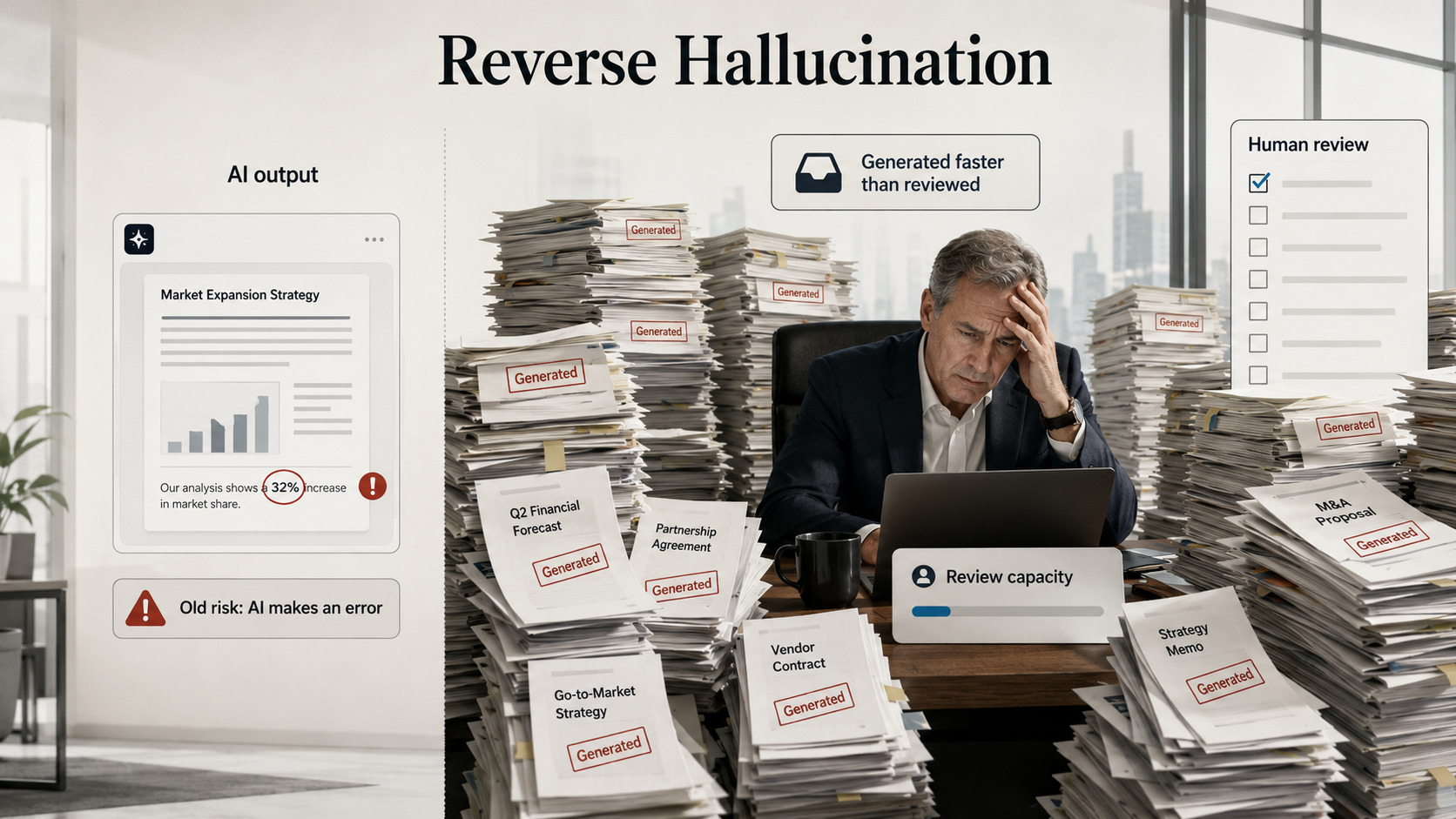
I'm calling it Reverse Hallucination: when people generate so much AI output that they lose grip on what they actually produced, and start shipping things they never really read.
The machine isn't making things up. The human just stopped checking.
Why This Is Happening
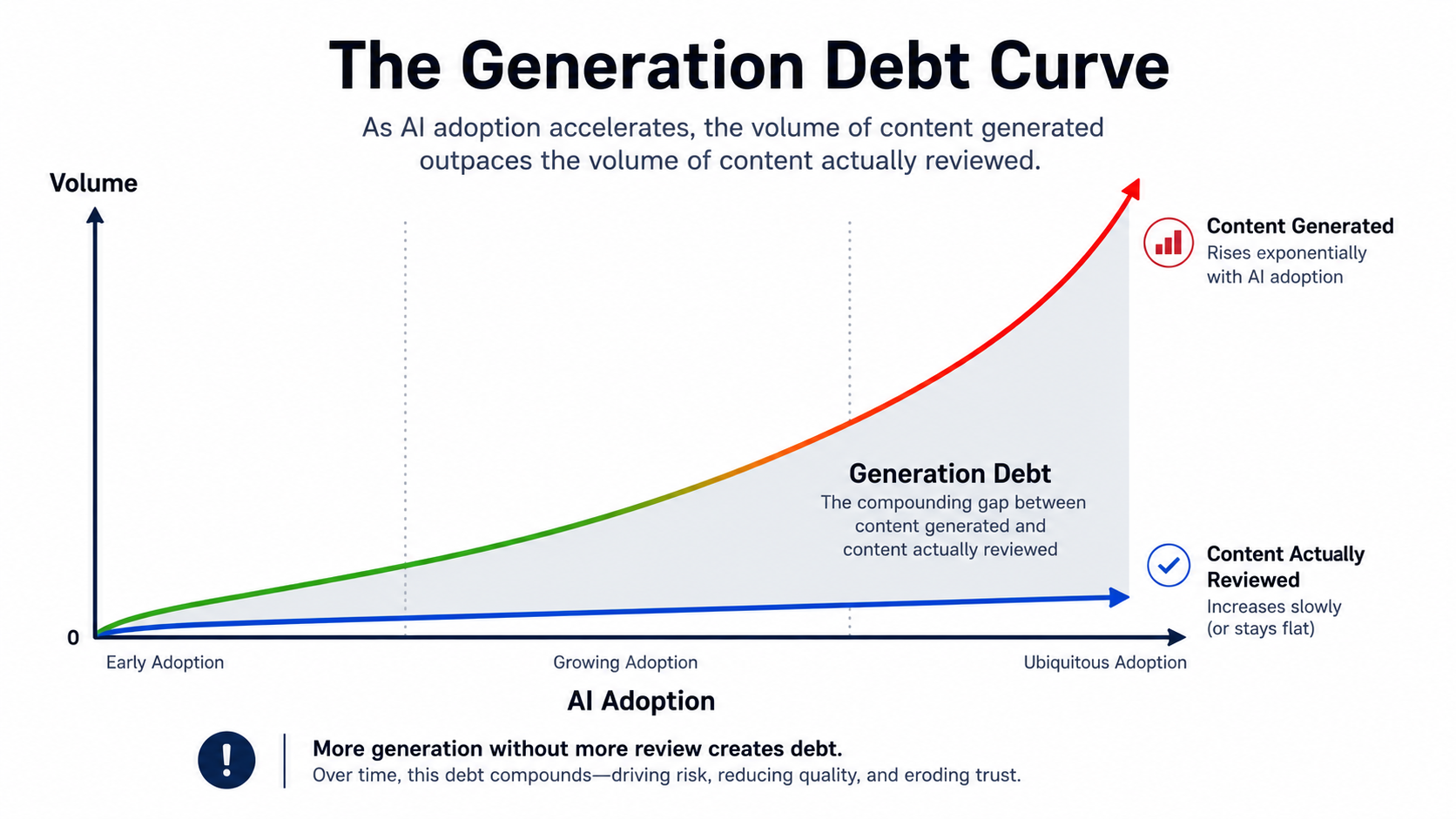
The root cause is simple economics. Generation used to be expensive. Now it's nearly free.
When writing a strategy document took a leader three days, they read every line of it. They had to. The cost of producing it forced them to value it. When drafting a contract took a lawyer hours, every clause was deliberate.
Now a strategy doc is one prompt. A contract is one prompt. A 40-page report is one prompt. And here's the trap: the cost of generating collapsed, but the cost of reviewing didn't. Reading 40 pages still takes the same time it always did.
So people generate far more than they can possibly review. The volume explodes. The attention stays fixed. The gap between what we produce and what we actually verify widens by the day.
"With great power comes great responsibility." We got the power. We quietly skipped the responsibility part.
What It Looks Like In The Wild
I've seen this pattern repeat across completely different functions, which is what tells me it's systemic, not isolated.
- The leader who generates strategy they don't read. An executive produces ten AI-generated planning documents for a quarterly review. They skim the first two. The rest get attached, forwarded, and acted upon. Decisions get made on the basis of content nobody senior actually read. The strategy has the appearance of rigor and none of the substance.
- The contract with clauses nobody chose. This one we experienced directly. An AI-drafted agreement came back with excessive clauses, some of which were genuinely not in our interest. The AI didn't hallucinate them. It generated reasonable-sounding boilerplate that padded the document. Because the volume was high and the language was plausible, the problematic clauses almost slipped through. If nobody reads carefully, "plausible" becomes "approved."
- The codebase full of features nobody asked for. Engineers generate entire modules in minutes. The feature works, so it ships. Three months later, nobody remembers why half the code exists, and a quarter of it is solving problems the product never had.
- The report that says everything and means nothing. Marketing, ops, finance. Every team is now capable of producing 50-page documents on demand. Length becomes a proxy for effort. But a document nobody reads in full is just expensive noise with a professional font.
Why It's More Dangerous Than AI Hallucination
AI hallucination is a known risk. We've built guardrails for it. We fact-check, we cite, we verify, we add retrieval grounding. The whole industry is on alert for it.
Reverse Hallucination is more dangerous precisely because nobody's watching for it. It hides behind the appearance of productivity. The documents look polished. The output is voluminous. The dashboards show activity. Everyone feels productive.
But underneath, the verification layer has quietly collapsed. And the errors that slip through aren't obvious AI mistakes. They're plausible, well-formatted, professional-looking errors that a human would have caught if they'd actually read the thing.
- The contract clause that costs you later.
- The strategy assumption that was never pressure-tested.
- The financial figure that nobody traced back to source.
These don't announce themselves. They sit quietly in documents nobody fully read until they become a problem.
The scariest part: the more output you generate, the more confident you feel, and the less of it you've actually examined. Volume creates a false sense of thoroughness. You produced a lot, so you feel covered. You're not.
How To Pay Down Generation Debt
The teams I see handling this well share a few habits:
- Generate less, on purpose. The first question shouldn't be "can AI produce this?" It should be "do we need this at all?" Most generated output is volume for the sake of volume. One sharp page beats forty padded ones.
- Read what you ship. All of it. If you generated it and your name is on it, you own it. Not "the AI wrote this." You wrote it, with help. That means you read it before it leaves your hands.
- Treat AI output as a first draft, never a final. The generation is the cheap 20%. The review, editing, and judgement is the expensive 80% that you can't skip. The value was never in producing the draft. It was in everything after.
- Cap document length deliberately. If a strategy fits on two pages, it gets read and pressure-tested. If it's forty, it gets skimmed. Brevity isn't just style, it's a forcing function for comprehension.
- Make someone accountable for every artifact. Every generated document needs a human who has read it end to end and will defend it. No owner, no ship.
The Honest Read
AI generation is genuinely transformative. The ability to produce a first draft of almost anything in seconds is a superpower. I use it constantly and I'm not giving it up.
But a superpower used without discipline becomes a liability. Reverse Hallucination is the cost of treating generation as the finish line when it's actually the starting line. The work was never in producing the output. It was in understanding it, refining it, and standing behind it.
The teams that win won't be the ones who generate the most. They'll be the ones who generate deliberately, review ruthlessly, and never confuse volume with value.
The machine stopped hallucinating a while ago. The real question now is whether we're still reading.