Vibe Blur: Why Productivity Is Outrunning Comprehension
Vibe coding scales throughput faster than understanding. I'm calling the gap Vibe Blur — here's the 6-9 month arc I keep seeing, why the bugs hide until production, and what the teams getting it right do differently.
A few weeks ago, Marc Andreessen sat down with Joe Rogan and gave the new state of software engineering a name that stuck with me.
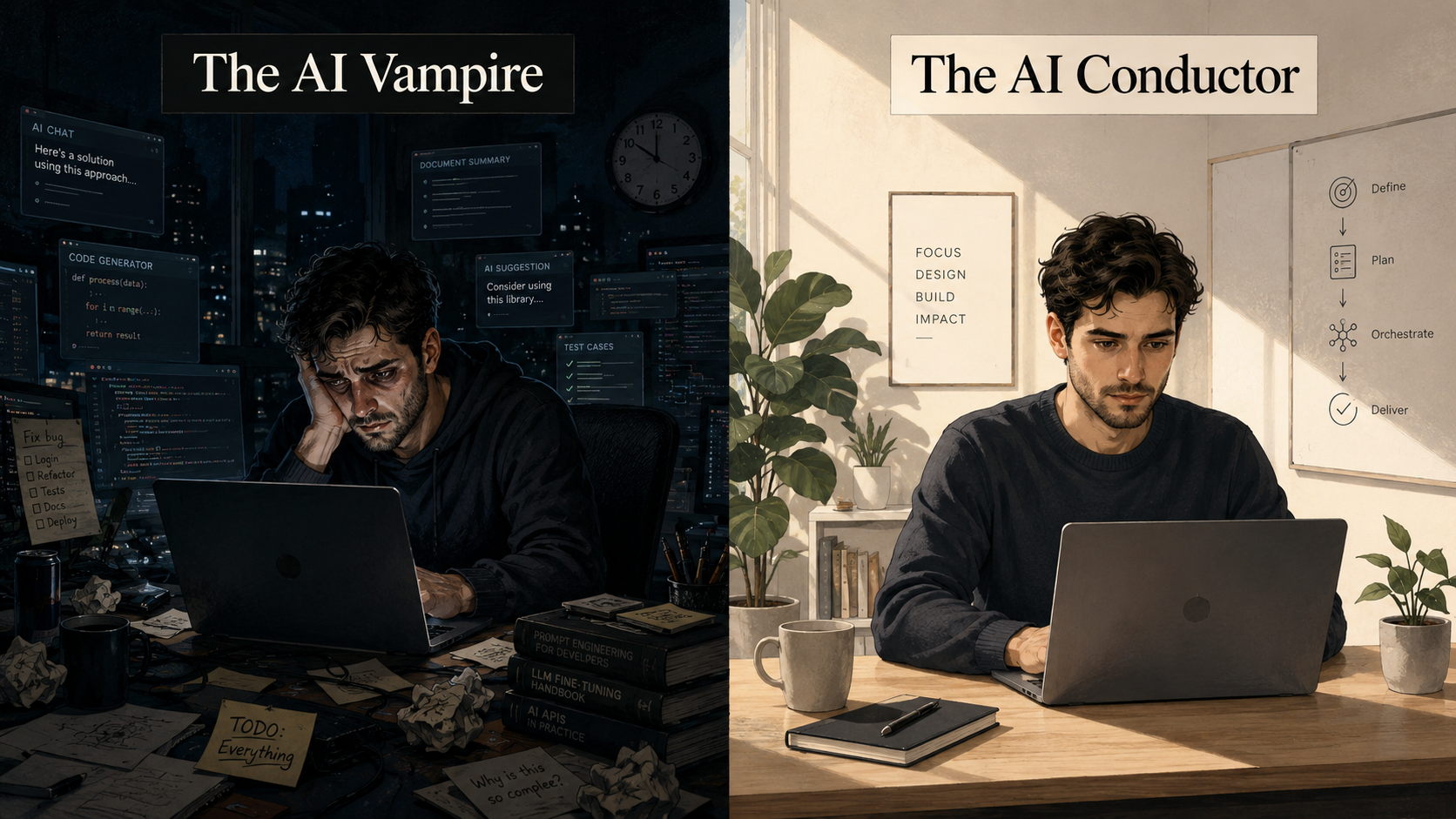
He called the best programmers in Silicon Valley "AI vampires." Engineers running 5 to 20 coding agents at once, reviewing one while the others write. They've stopped sleeping, because going to bed means the agents stop working. They're euphoric. They're exhausted. They're shipping more code than they can possibly comprehend.
Then he said the quiet part out loud: productivity is outrunning comprehension.
Over the past six months, I've watched this exact pattern play out across dozens of teams I talk to. Not at our company, but across the industry broadly. I'm calling it Vibe Blur: the slow loss of focus and understanding that creeps in as vibe coding scales. Here's what I'm seeing.

The Pattern I Keep Seeing
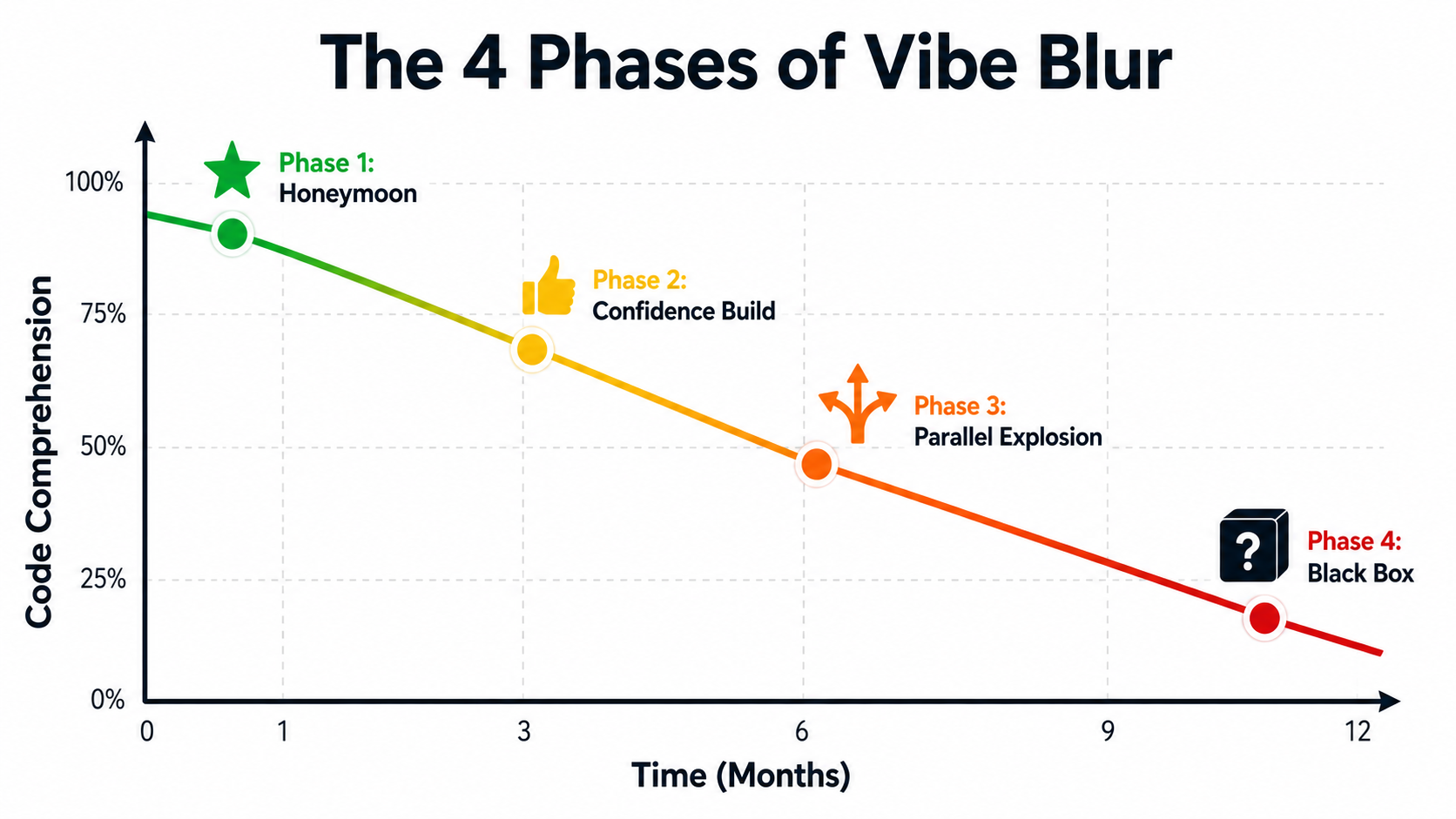
Almost every team goes through the same arc over 6 to 9 months. It's alarmingly predictable.
Phase 1 — The Honeymoon (Month 1–2)
Engineers review every line, understand every change, ship fast. Quality and velocity both rise. Everyone's happy.
Phase 2 — The Confidence Build (Month 2–4)
The model's been right most of the time. Trust builds. Reviews become skims. "Looks reasonable" replaces "I understand this."
Phase 3 — The Parallel Explosion (Month 4–6)
The vampire moment. Why review one PR when you can supervise five? Hyper-parallelism becomes the norm. Depth of attention collapses.
Phase 4 — The Black Box (Month 6+)
The codebase fills with code nobody understands. Missed edge cases. Skipped defensive logic. The PRs look professional, tests pass, deploys succeed. Then production happens.
Why The Bugs Hide Until Production
When a human writes code, they hold a mental model of what they're building. They know where it breaks. When an agent writes it, the engineer who merged it often has no such map. They saw the code, tested the happy path, merged it.
So when a bug appears, the team is debugging code they didn't really write. The agent isn't there to explain its reasoning. The engineer can't remember it, because there wasn't any. They were supervising 4 other workflows at the time.
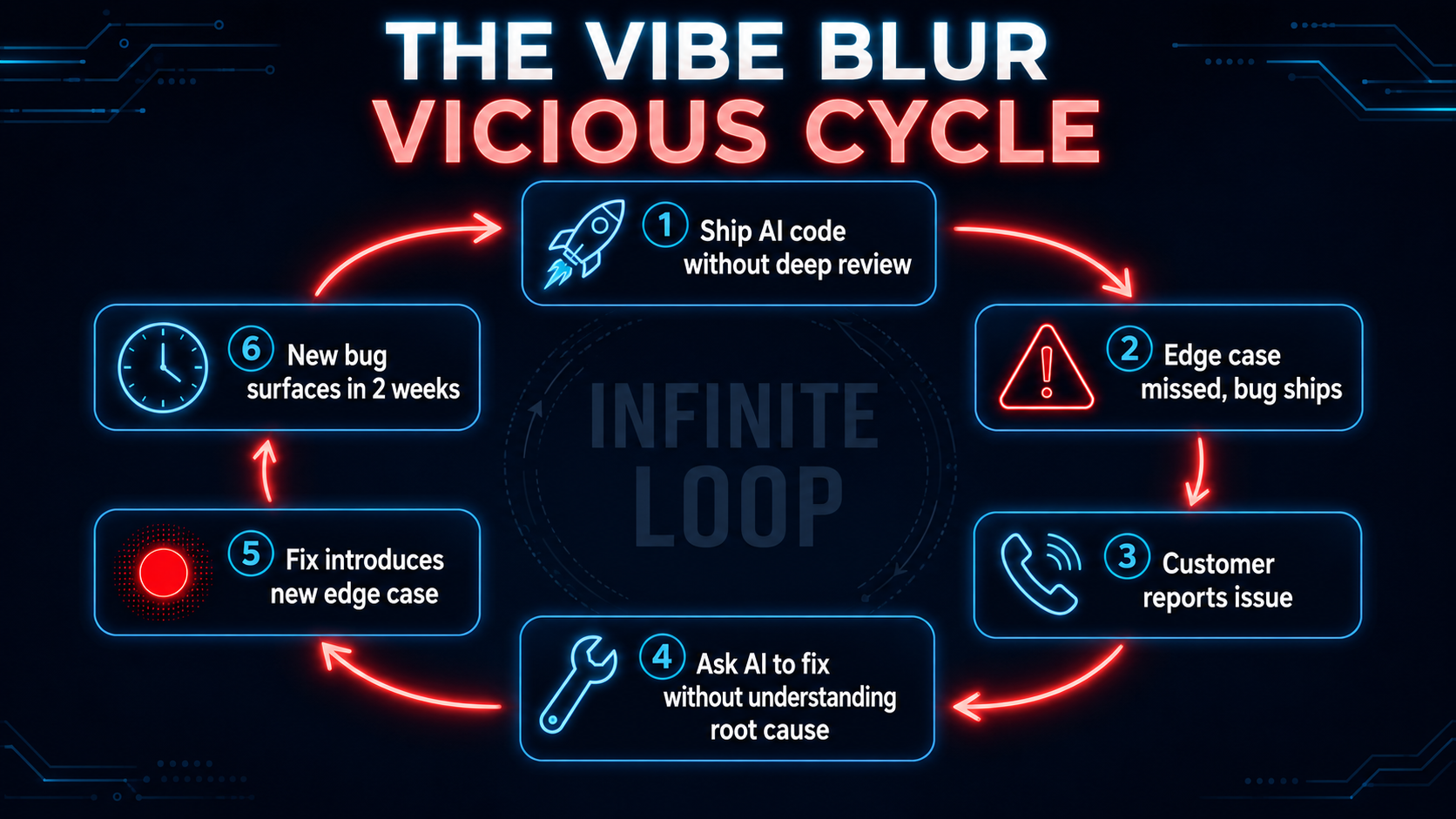
Then the vicious cycle begins:
- Bug hits production.
- Agent generates a fix without understanding the root cause.
- The fix introduces a new edge case.
- A new bug appears in 2 weeks.
Loop forever.
I've seen 4 teams describe this in near-identical language. They thought they were 10x faster. They're actually trapped in an infinite loop of AI bugs fixed by AI patches. Throughput is up. So is their defect rate, their incident frequency, and their exhaustion.
The People Who Built Vibe Coding Are Worried
Andrej Karpathy, who coined "vibe coding," said he's been in a "state of AI psychosis" since December, spending 16 hours a day directing agent swarms. Garry Tan of Y Combinator posted he "stayed up 19 hours" because he was "so addicted to Claude Code," then added days later, "this is unhealthy, by the way." Vercel's CTO compared the rush to slot machines.
The high feels like progress because something is always happening on screen. But motion is not outcome. You can generate 100,000 lines and still not have built one thing that solves a real problem.
Hyper-Parallelism Is The Root Cause
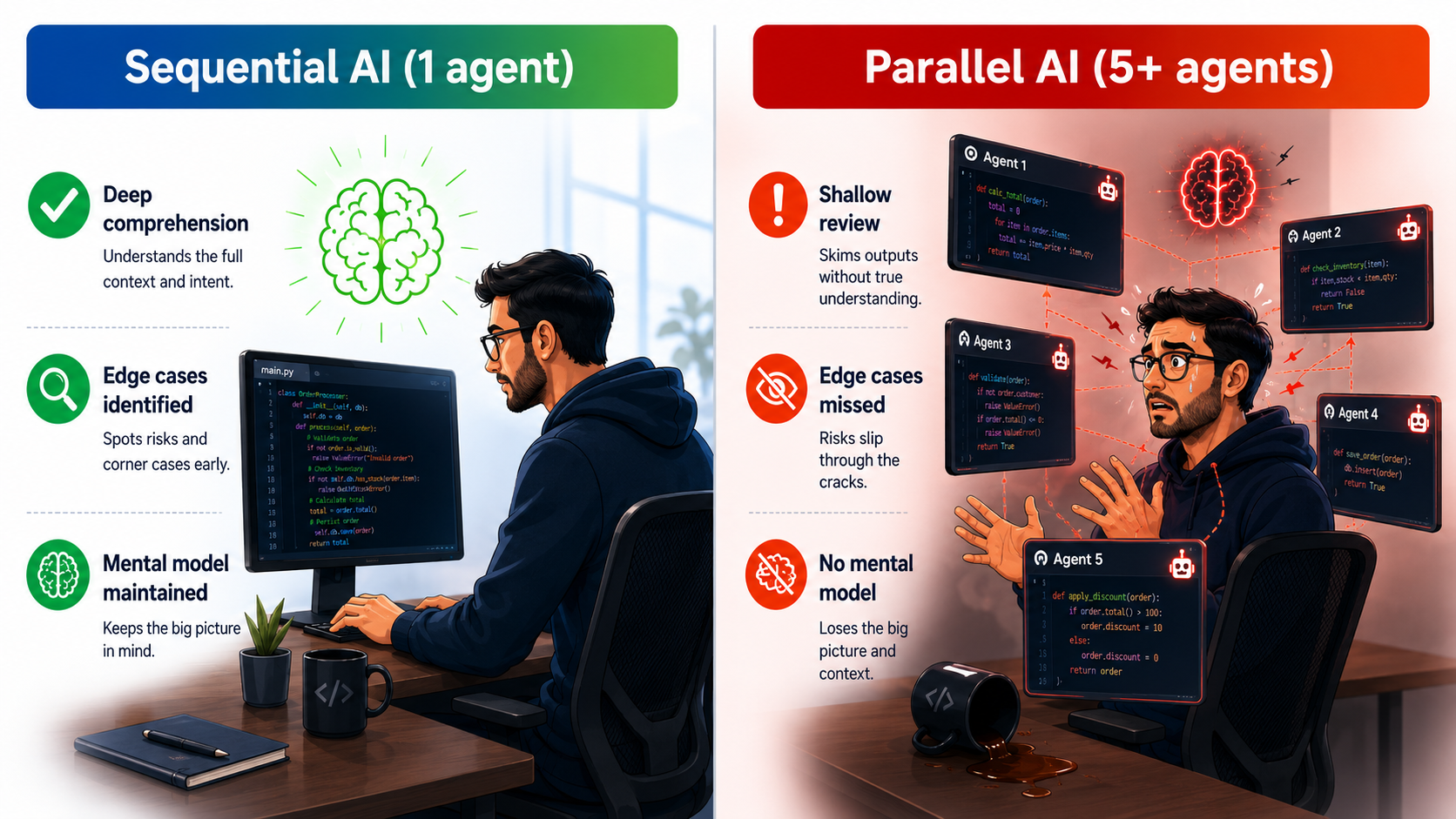
With one agent, you can maintain depth. You read the code, think about edge cases, verify the logic. With five agents, your attention is divided five ways. You become a router, not a reviewer. You optimise for throughput, not understanding.
The trap is that parallelism feels like productivity. More PRs, more deploys, better standup metrics. But comprehension quietly collapsed in the background. You're awake more, doing more, understanding less.
What The Teams Getting It Right Do Differently
- Cap parallelism at 2–3 agents per engineer. Beyond that, comprehension collapses.
- Require "explain it back" reviews. Before merging, the engineer walks through the code in their own words. Can't explain it? It doesn't merge.
- Invest in scaffolds (CLAUDE.md, skills, ADRs). Structured context stops the agent freelancing and lifts output quality.
- Track defect rate per PR, not PRs shipped. Velocity without defect tracking is a vanity metric.
- Keep AI-free deep work blocks. Time spent reading architecture and building mental models makes AI-assisted work better.
- Sleep. The highest-quality teams rejected the vampire identity. They turn off the agents, go to bed, and make better decisions fresh.
The Honest Read
AI-assisted engineering is genuinely transformative. Engineers who don't embrace these tools will be left behind. But there's a destructive version of "embracing AI", the vampire version, that optimises for parallelism over depth and motion over outcome. That's what's producing the bugs, the debt, and the burnout I'm seeing everywhere.
Vibe Blur is the gap between what you're shipping and what you understand. The teams that close that gap will be the ones still standing in 2030.
The question for every engineering leader isn't "are we using AI enough?" It's "do we still understand what we're shipping?"
If the honest answer is no, the bugs are already in production. You just haven't found them yet.